
A NOTE BEFORE YOU BEGIN
This post is Part 1 of a four-part series. It is not intended to stand alone. Over the coming weeks, I’ll link the remaining posts here as they’re published.
Together, they explore the cross not as doctrine, but as orientation — a way of standing in the world, thinking clearly, and enduring tension without losing meaning.
A Shape We Almost Stop Seeing
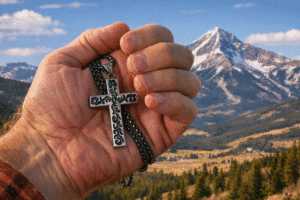
At first glance, the cross is familiar almost to the point of invisibility. It hangs on walls, rests on altars, appears on maps, flags, jewelry, and gravestones.
Even for people who don’t consider themselves religious, the shape is instantly recognizable. Two lines. One vertical. One horizontal.
Simple. Direct. Unavoidable.
At the most obvious level, the cross symbolizes Christianity and, more specifically, the crucifixion of Jesus. It recalls suffering, sacrifice, and death—followed, for believers, by resurrection.
This alone explains much of its power. It marks a moment where injustice, violence, and pain are not denied or softened but placed squarely at the center of the story. The cross says: this happened. It mattered. It still does.
Before Theology, Geometry
But the cross works even before theology enters the room.
Strip away doctrine and narrative for a moment, and what remains is geometry. The cross is an intersection. A vertical line running up and down. A horizontal line stretching left and right.
Across cultures and centuries, humans have used this shape to orient themselves in the world. It maps space. It marks direction. It creates a center.
The vertical line has always pointed beyond the human plane—upward toward the sky, the heavens, the unseen, the infinite. Downward, it points toward the earth, the body, the grave, the weight of material existence. The horizontal line moves through time and relationship: past to future, self to other, tribe to tribe. It is the axis of lived life—where conflict, love, work, loss, and meaning unfold between people.
Where these two lines cross, something important happens.
Meaning at the Intersection
The cross quietly insists that meaning does not live exclusively above us, in abstraction or escape, nor does it dissolve entirely into survival, instinct, or chaos. Meaning appears at the intersection—where the eternal touches the everyday, where ideals meet reality, where the infinite presses into a single, finite life.
This is why the cross feels heavy even when it is small.
As readers move deeper, another layer reveals itself: the cross is not balanced by accident. In most traditional forms, the vertical beam is longer than the horizontal. Symbolically, this suggests that transcendence, purpose, or calling outweighs comfort and convenience—but never eliminates them. The horizontal beam is still there. Human life, relationship, and suffering are not bypassed. They are endured, held, and carried.
The cross does not promise an easy way out. It promises orientation within difficulty.
A Compass, Not a Conclusion
This helps explain why the cross appears far beyond Christianity. Variations of it show up in ancient cosmologies, indigenous medicine wheels, mandalas, and early maps of the world. Long before it became a religious emblem, the cross functioned as a compass of meaning—a way of saying: stand here, face the tension, do not flee upward into fantasy or collapse downward into despair.
Read this way, the cross is less a statement to believe and more a position to inhabit.
It says that life will stretch you vertically—toward questions of purpose, truth, and transcendence—and horizontally—through relationships, wounds, obligations, and time. The point is not to resolve that tension, but to remain conscious within it.
By the time Christianity places a body on the cross, the shape is already doing its work. The crucifix intensifies the message: meaning is not found by avoiding suffering, but by standing fully present within it—without denial, without escape, and without losing sight of what lies beyond.