A NOTE BEFORE YOU BEGIN
This post is Part 3 of a four-part series. It is not intended to stand alone. Over the coming weeks, I’ll link the remaining posts here as they’re published.
Together, they explore the cross not as doctrine, but as orientation — a way of standing in the world, thinking clearly, and enduring tension without losing meaning.
A Language Meant to Be Recognized, Not Explained
Once you begin to see the cross as more than a shape, the crucifix opens another layer entirely. What appears at first to be a single image—Christ on the cross—is often a dense field of symbols, many of them small, quiet, and easy to miss. These markings were never meant to explain the story. They were meant to compress it.
Crucifixes were created for people who already knew the narrative. The symbols function like shorthand, allowing a viewer to read meaning at a glance, or to return to it slowly over time. Nothing is accidental.
INRI: Power That Names Without Understanding
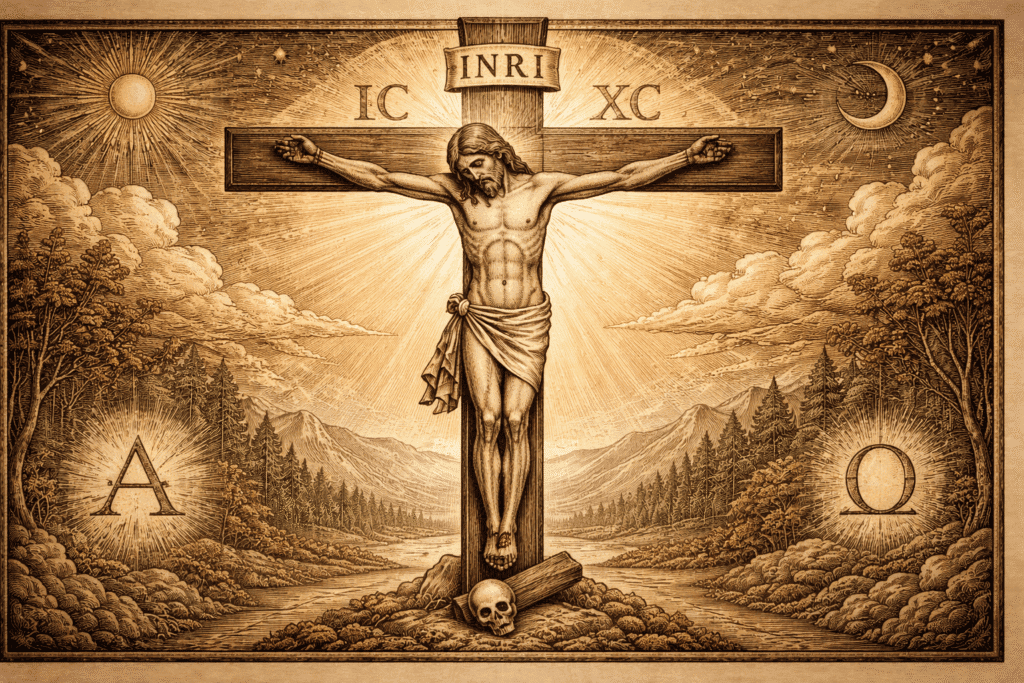
The most obvious inscription is INRI, usually placed above Christ’s head. These letters come from the Latin phrase Iesus Nazarenus, Rex Iudaeorum—“Jesus of Nazareth, King of the Jews.”
Historically, it was a charge posted by Roman authorities, intended as mockery and warning. Symbolically, it becomes something else entirely. The title meant to humiliate is preserved, inverted, and reclaimed. Power names truth without understanding it.
IC XC: Presence Stretched Across Humanity
Often carved near the arms of the cross are the Greek letters IC XC, short for Iēsous Christos—Jesus Christ. These letters frequently span the horizontal beam, placing the name of Christ across the axis of human relationship and suffering.
The message is spatial rather than verbal: presence is not above or beyond humanity, but stretched across it.
Alpha and Omega: Time Compressed
You may also notice Alpha and Omega (Α Ω) engraved near the top and bottom of the vertical beam. These letters signify beginning and end, origin and completion.
When placed on a crucifix, they compress all of time into a single moment. Birth, death, and transformation are not separate events but part of one continuous arc.
Sun and Moon: Cosmic Witness
Some crucifixes include a sun and moon, small and subtle, often positioned on opposite sides of the cross. These ancient symbols predate Christianity and were deliberately absorbed into its visual language.
They represent cosmic witness—day and night, conscious and unconscious, masculine and feminine, time and eternity. Their presence signals that the crucifixion is not merely historical, but cosmic in scope.
Nails: Where History Ends and Symbol Begins
Another frequent symbol is the number and placement of nails. Some traditions show four nails—one for each hand and foot—emphasizing realism and physical suffering. Others show three nails, symbolically referencing the Trinity.
History leaves this ambiguous, and symbolism fills the gap. Theology steps in where certainty ends.
The Skull at the Base: Death Remembering Its Origin
At the base of the cross, you may see a skull, sometimes easy to overlook. This refers to Golgotha, “the place of the skull,” but tradition adds another layer: the skull of Adam.
The symbolism is striking. At the site of death, the origin of humanity is remembered. Redemption flows downward into history itself.
The Slanted Footrest: Direction Still Matters
In Eastern Christian crucifixes, you may notice a slanted footrest—a small diagonal bar near Christ’s feet. This detail carries moral weight.
One side tilts upward, the other downward, representing the two thieves crucified alongside Christ: one repentant, one defiant. The message is unsettling in its simplicity. Even in suffering, direction still matters.
Posture and Expression: Theology Without Words
The posture of Christ’s body also communicates meaning. A slumped head and closed eyes emphasize full humanity and death. In some traditions, Christ appears serene rather than broken, signaling victory through endurance rather than defeat through violence.
These choices reveal theology without words.
A Language That Waits
Taken together, these symbols form a visual language. They do not argue. They do not persuade. They wait.
A crucifix does not demand to be decoded all at once. It rewards patience. The more time you spend with it, the more it gives back—not through explanation, but through recognition.
Looking Ahead
In the final post, we’ll look at how these symbols appear on one specific crucifix—and how to read what is present, what is absent, and what that combination quietly reveals.