A NOTE BEFORE YOU BEGIN
This post is Part 2 of a four-part series. It is not intended to stand alone. Over the coming weeks, I’ll link the remaining posts here as they’re published.
Together, they explore the cross not as doctrine, but as orientation — a way of standing in the world, thinking clearly, and enduring tension without losing meaning.
From Outer Symbol to Inner Map
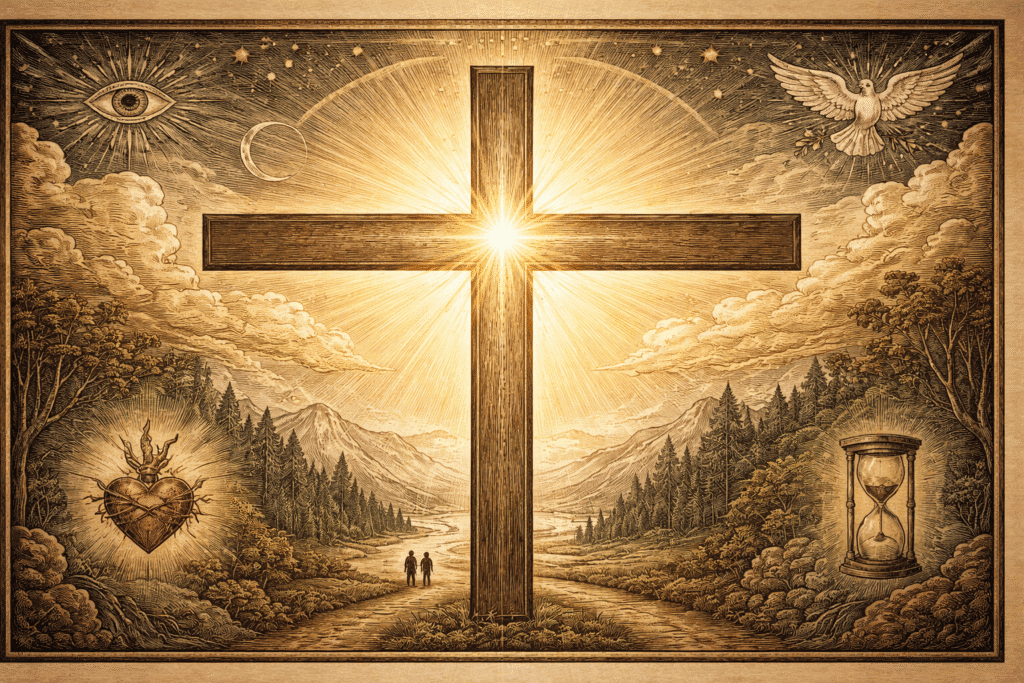
If the first way to read the cross is outward—history, culture, and visible meaning—the second way is inward. Here, the cross stops being something we look at and becomes something we live within. It functions less like a symbol on a wall and more like a map of the human interior.
The vertical and horizontal lines still matter, but now they describe experience rather than theology.
The Vertical Axis: Meaning and Mortality
The vertical line represents our relationship with meaning itself. It stretches upward toward ideals, values, faith, imagination, and transcendence—the sense that life points beyond survival. It also stretches downward into the body, instinct, fear, grief, and mortality.
This is the axis along which we wrestle with questions like: Why am I here? What matters enough to suffer for? What remains when control disappears?
The Horizontal Axis: Relationship and Time
The horizontal line represents life as it actually unfolds between people. This is the realm of relationship, conflict, responsibility, memory, and time. It includes love and betrayal, belonging and exile, stability and disruption.
It is where wounds are formed—not in abstraction, but through contact with others.
The Cost of Separation
The cross insists that these two axes cannot be separated without cost.
Many people lean heavily into one direction and neglect the other. Some try to live purely on the vertical axis—chasing meaning, transcendence, or spiritual purity while bypassing messy human realities. Others collapse into the horizontal—managing relationships, crises, and survival without any larger framework of purpose.
Both approaches eventually fracture.
The Discipline of the Intersection
The cross presents a third option: stay at the intersection.
This is the most difficult place to stand. It is where ideals are tested by reality and where suffering is not allowed to erase meaning. It is also where denial becomes impossible.
At the center of the cross, one cannot escape upward into fantasy or sideways into distraction. One must remain present.
Consciousness Under Pressure
Psychologically, this intersection corresponds to conscious awareness under pressure. It is the moment when a person holds opposing truths at once: hope and despair, love and loss, strength and vulnerability.
Rather than resolving the tension, the cross teaches endurance within it.
Why the Crucifixion Image Endures
This is why the crucifixion narrative matters beyond belief. The image of a body held at the intersection of vertical and horizontal axes is a visual claim about human life itself.
It says that transformation does not occur by avoiding pain or pretending it has meaning prematurely. Meaning emerges by carrying pain consciously—without letting it harden into bitterness or dissolve into chaos.
Stillness Without Escape
Notice something subtle: the cross does not move. The figure upon it does not escape. There is no bypass.
This stillness is part of the symbol’s power. It reflects the moments in life when movement is no longer possible—when choices narrow, when consequences arrive, when we are forced to face what is rather than what we wish were true.
Integration, Not Resolution
And yet, the cross is not a dead end.
As an inner map, it suggests that the very place of greatest tension can become the site of integration. When a person can remain present at the intersection—holding grief without collapse, meaning without illusion, responsibility without resentment—something shifts.
Not immediately.
Not magically.
But gradually, depth forms.
Looking Ahead
This is why the cross continues to resonate even for those who struggle with doctrine or belief. It does not demand certainty. It demands honesty.
It asks a single question: Can you remain conscious here?
In the next post, we will move from the invisible to the visible—breaking down the most common symbols carved into crucifixes themselves. These small engravings are not decoration. They are condensed meanings, designed to speak to those who already know how to look.