I’ve never been drawn to symbology or numerology as a way to predict the future. That’s not where the magic is for me. What fascinates me is something far subtler—and far more powerful: the way symbols and numbers act as mirrors for the subconscious. Or, if you prefer another term, the “higher self.”
We don’t discover meaning in symbols so much as recognize it.
The meaning shows up based on what we’re living through, what we’re wrestling with, what we’re ready to understand. In that sense, symbols don’t tell us what will happen. They reveal what’s already happening inside us—sometimes before we’re conscious of it.
That’s why some people find symbology and numerology frightening. If you think they’re external forces exerting control, they can feel ominous. But if you understand them as reflective tools—psychological, creative, spiritual—they become fascinating. They sit right at the crossroads of ancient human knowledge, creativity, psychology, and mysticism.
That intersection is where I like to live.
Wired for Symbols
Human beings are hard-wired for symbolic understanding. Long before written language, long before formal mathematics, we communicated through images, colors, shapes, and rhythm. We painted on stone. We carved into trees. We told stories with animals, stars, seasons, and cycles.
Numbers came later—not as abstractions, but as observations.
People counted how the planets moved. They tracked the moon. They watched the sun rise and fall, measured shadows, and noticed patterns. Over time, those patterns became cycles. Those cycles became calendars. And calendars became a way to align human behavior with what appeared to be a larger order.
Numerology, at its root, isn’t mystical nonsense—it’s pattern recognition layered with meaning. The same way music is math you can feel, numerology is math you can interpret.
Meaning Is Assigned, Not Imposed
Here’s the part that matters most to me: meaning is not universal or fixed. It’s contextual.
We assign meaning to symbols and numbers based on what we’re going through or what we need to learn. The same symbol can mean entirely different things to two people—or to the same person at different points in their life.
That’s not a flaw. That’s the feature.
It’s no different than how a piece of music can wreck you at one moment in your life and feel neutral at another. The music didn’t change. You did.
Symbols work the same way.
My Native Tongue
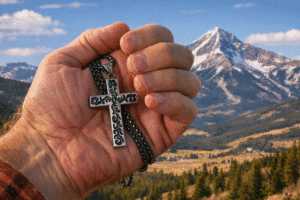
You’ll notice that much of my symbolism and numerology is rooted in Christianity—specifically Seventh-day Adventism. That’s not because I believe Christianity has a monopoly on truth. It’s because it’s my native tongue.
The Seventh-day Adventist tradition is one of the few Christian sects that still honors the original Sabbath—the seventh day. That emphasis on cycles, rest, rhythm, and order shaped how I learned to see the world long before I ever questioned theology.
Oprah Winfrey once described Christianity as her “native tongue.” She was raised Southern Baptist, and even as her beliefs expanded beyond any single tradition, she still had to pass higher truths through a Christian lens to truly understand them.
That idea stuck with me.
It doesn’t mean Christianity is the destination. It means it’s the language I learned first.
Translation Is Still Understanding
If I decided to learn German at age 57, I wouldn’t suddenly stop thinking in English. I’d translate. I’d compare. I’d map unfamiliar structures onto familiar ones. Over time, fluency might grow—but English would always be the foundation.
Spiritual understanding works the same way.
I don’t discard my roots to explore broader truths. I translate through them. It’s imperfect—but it’s honest. And honesty matters more than purity.
Every tradition does this. Buddhism. Judaism. Indigenous cosmologies. Physics, even. Each is a symbolic system pointing toward something larger than itself.
Creativity Lives Here
This is why symbology and numerology feel creative to me, not restrictive.
They’re not cages. They’re lenses.
They give form to intuition. They offer structure without demanding certainty. They allow meaning to emerge without forcing interpretation. When used lightly—playfully, even—they become tools for reflection rather than dogma.
That’s also why I’m careful not to push these ideas too hard or too literally. Symbols are powerful precisely because they’re flexible. The moment they become rigid, they lose their usefulness.
At the Crossroads
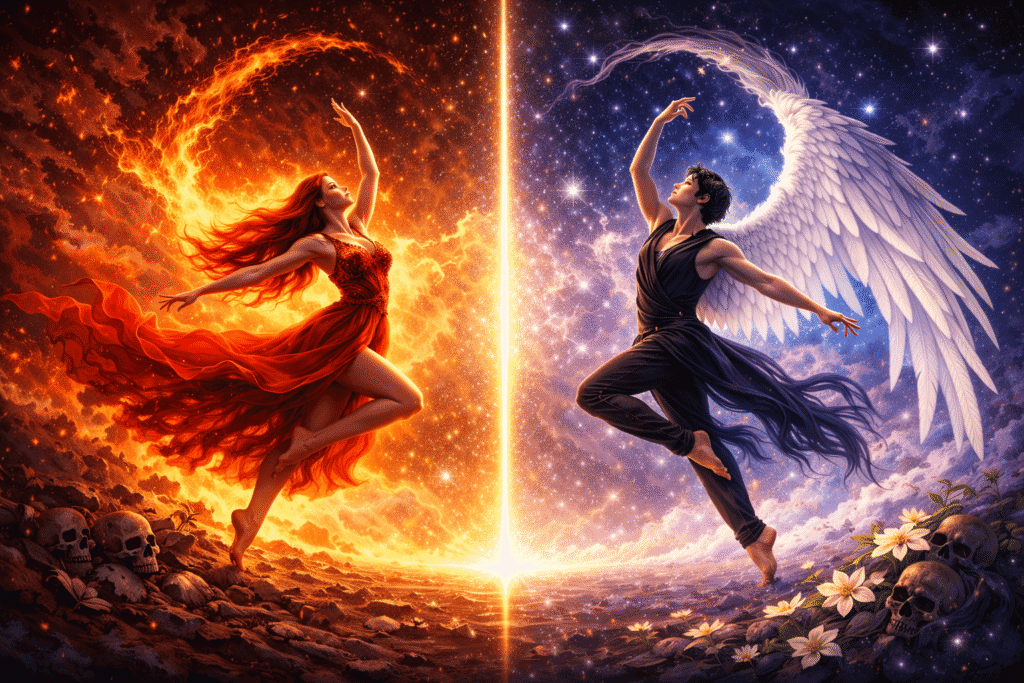
I love symbology and numerology because they sit at a crossroads humans have always occupied: between what we can measure and what we can feel, between order and mystery, between logic and imagination.
They remind me that understanding doesn’t always arrive as an answer. Sometimes it arrives as a pattern you suddenly notice—and can’t unsee.
And that’s enough.
Not to predict.
Not to control.
Just to recognize.
That, to me, is where the real meaning lives.