I was raised Seventh-day Adventist.
That sentence alone carries a lot of freight. For some people, it conjures potlucks, sabbath school felt boards, and vegetarian casseroles. For others, it brings up apocalyptic charts, beasts, timelines, and warnings about the end of the world.
For me, it was something quieter and deeper than all of that: a childhood formed inside a single, powerful story—what Adventists call The Great Controversy.
Not Dates or Doom, but Alignment
At its core, The Great Controversy is not about dates or doom. It’s about alignment.
The story goes like this: the universe is ordered, intelligent, and good. At its center is a governing principle—love, harmony, law, relationship. One of the highest created beings, Lucifer, becomes dissatisfied with his position. Not because he lacks beauty or intelligence, but because he wants sovereignty rather than service. The fall is not about ugliness. It’s about pride. Misalignment. A refusal to remain oriented toward something greater than the self.
Earth becomes a contested space. Not a throne, not a prize—but a proving ground. A place where freedom, choice, and consequence play out in real time.
Power, Position, and Misplacement
Whether or not one believes that story literally, growing up inside it leaves a mark. You learn early that power and position are not the same thing. That intelligence without humility can distort. That being “fallen” doesn’t mean evil so much as out of place.
I didn’t carry Adventism with me as doctrine into adulthood. But I carried its geometry. Its way of seeing orientation, order, rebellion, and return.
And that’s probably why certain symbols still land so hard for me.
Why Ravens
Like ravens.
Early this winter in southwest Montana, there were ravens everywhere. Not one or two—but dozens. Maybe hundreds. They gathered during the cold snap, loud and watchful, filling the sky and the cottonwoods. And then, just as suddenly, they were gone. The weather warmed. The land shifted. The system adjusted.
No omen. No warning. Just intelligence responding to conditions.
Ravens have always been symbolic carriers across cultures—not because they predict the future, but because they observe. In Norse myth, Odin’s ravens fly the world each day and return with information: Thought and Memory.
In modern storytelling, like Game of Thrones, ravens carry messages across vast distances. They don’t interpret the message. They don’t editorialize. They just deliver it.
Carried, Not Rescued
Which brings me, oddly enough, to a lyric that has followed me for years.
“Deliver me in the belly of a black-winged bird.”
That line from The Black Crowes has always felt heavier than rock poetry. It isn’t about rescue from darkness. It’s about passage through it.
The word belly matters. Belly is womb language. Shelter. Darkness that transforms rather than destroys. To be carried in the belly of a black-winged bird is not to be saved from the storm, but to be transported by it.
That’s initiation language.
The Rain King and the Queen
And when Adam Duritz sings it in Rain King, it’s paired with two other phrases that deepen the picture: “I am the Rain King” and “in the service of the Queen”.
The Rain King is not a ruler in the way modern power imagines rulers. He doesn’t command the weather. He lives inside it. Rain is renewal, grief, grace—something that falls whether you’re ready or not. To call yourself the Rain King is to accept immersion rather than control.
And the Queen? In blues and gospel traditions, the Queen is rarely about hierarchy. She’s the feminine ordering principle: nature, truth, love, grace, the muse. The thing you serve rather than conquer. To say “I belong in the service of the Queen” is to reject sovereignty in favor of devotion.
The Great Controversy, Revisited
Which is where, unexpectedly, my Seventh-day Adventist upbringing comes back into view.
In Ellen G. White’s telling of The Great Controversy, Lucifer’s fall is not caused by curiosity or creativity. It’s caused by a refusal to serve. A desire to rule rather than participate. Redemption, in that framework, is not about punishment or reward—it’s about restored alignment.
Seen that way, the voice in Rain King doesn’t sound like rebellion at all. It sounds like awareness. Like a being that knows it is not whole and is choosing position over power.
Fallen, But Not Defiant
If there is “fallen angel” imagery here, it isn’t defiant. It’s humble. It’s pre-restoration language. Not “I will ascend,” but “carry me.” Not “I will rule,” but “I serve.”
That distinction matters.
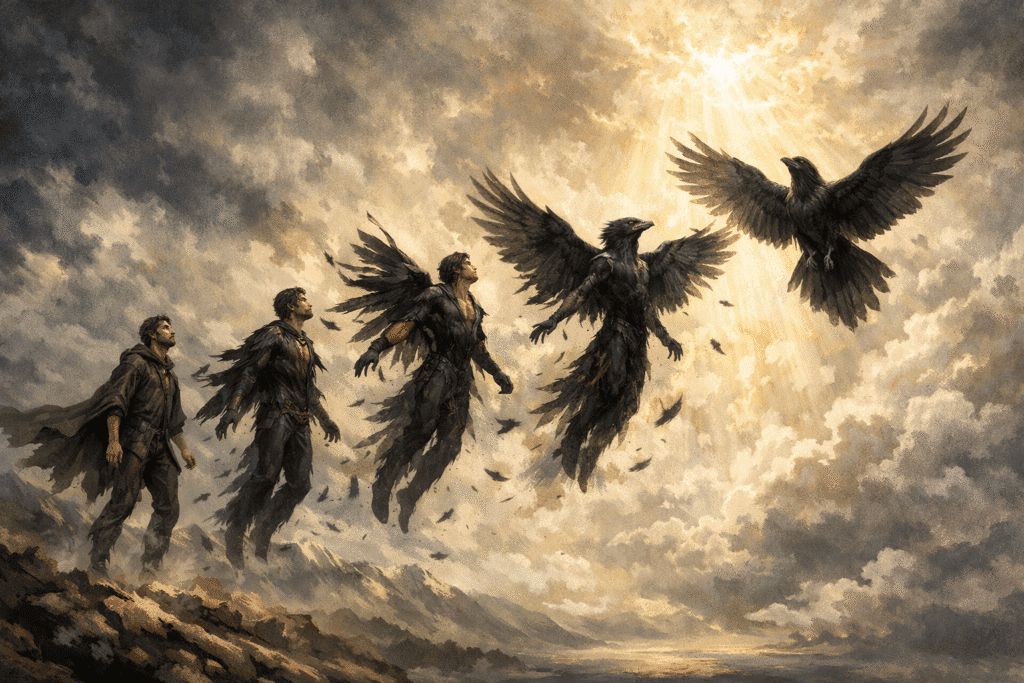
Because a fallen being, in the Great Controversy story, is not monstrous. It’s intelligent, mobile, observant—but misoriented. The tragedy isn’t darkness; it’s dislocation. And the hope is not domination, but return.
Edges, Weather, and Movement
That’s why ravens feel like the right symbol.
Ravens don’t belong to cities the way crows do. They belong to edges. Wilderness. Weather. They’re comfortable in harsh conditions. They arrive when systems tighten and disperse when pressure lifts. They don’t stay for applause. They don’t linger to be interpreted.
They come, observe, and move on.
Which is exactly how certain ideas move through a life.
Meaning as Recognition
I don’t read symbolism or numerology as prediction. I don’t believe numbers or birds or lyrics tell us what will happen. I believe they reveal what we’re ready to notice. They act as mirrors for internal states, not forecasts.
The meaning isn’t imposed from outside. It’s recognized from within.
Growing up Seventh-day Adventist trained me—perhaps unintentionally—to think in terms of orientation. To ask not “Who’s winning?” but “Who’s aligned?” To see storms not as punishment, but as conditions. To understand that falling is less about breaking rules and more about losing position.
Correctly Placed
So when the ravens gathered, and then left, I didn’t read it as an omen. I read it as intelligence in motion.
And when I hear a line like “deliver me in the belly of a black-winged bird,” I don’t hear escape. I hear consent. Consent to be carried through something difficult by forces older, calmer, and more ordered than my own fear.
That’s not theology.
That’s posture.
And maybe that’s the quiet through-line connecting Seventh-day Adventism, Norse myth, Southern blues, Montana winters, and a rock song written decades ago: the idea that life isn’t about standing above the storm, but learning where to stand within it.
Not sovereign.
Not helpless.
Just correctly placed.
Carried, when necessary.