
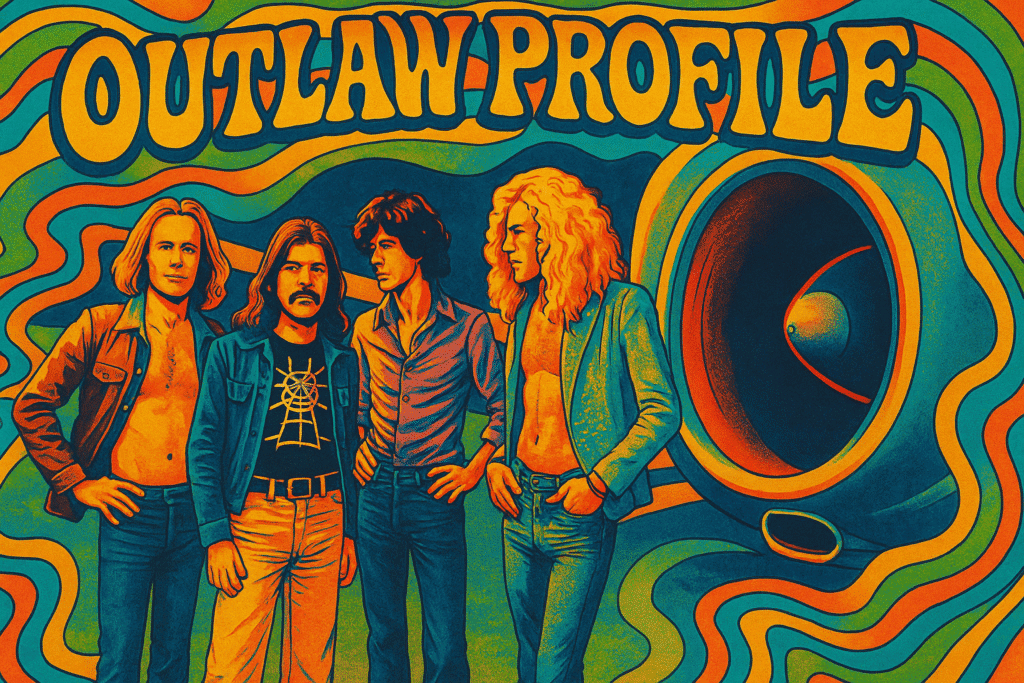
On a recent trip between Portland, Maine and Bozeman, Montana, I finally had the chance to watch the documentary Becoming Led Zeppelin. It struck me as the perfect starting point for this new series “OUTLAW PROFILES”—because Zeppelin wasn’t just a band, they were outlaws.
The film actually screened in Bozeman earlier this year, at the theater on Main Street that shows independent films. I wish I could have caught it there—there’s something about watching a story of outlaws in the heart of Montana that would have felt right. But I missed it. That’s the reality of my life split between Maine and Montana: sometimes I’m in one place when I wish I were in the other.
Most of the music industry in the late ’60s was built around singles. Record companies pushed quick hits, chasing radio play and the charts. But Jimmy Page insisted on something different. He wanted albums that told a story, works that stood on their own. To do that, they had to own the project. They self-financed, took the risk, and bet on themselves. That’s an outlaw move if there ever was one.
The Band of Outlaws
- Jimmy Page (guitar): A visionary with a style that blended blues, folk, and hard rock into something entirely new. His refusal to play by the rules—insisting on full albums and experimenting with sound layering—redefined what rock could be. Before Zeppelin, Page had been in many bands and was already a sought-after session player, but he was restless, always searching for more.
- Robert Plant (vocals): With a voice that was equal parts raw power and mystical poetry, Plant’s singing didn’t just hit notes—it painted landscapes. His “outlaw” spirit was in his refusal to sing safe, radio-friendly lines. Instead, he channeled myth, blues, and primal energy. Like Page, Plant had been in many bands before Zeppelin, failing forward until the right chemistry sparked.
- John Paul Jones (bass/keys): The quiet outlaw. A multi-instrumentalist who could move seamlessly from thunderous bass lines to orchestral arrangements. He broke boundaries not by being loud, but by redefining the role of a “backing” player.
- John Bonham (drums): A storm on the kit. His drumming was violent, swinging, and impossibly precise all at once. He refused to be just the rhythm section—his playing demanded center stage.
From Flop to California Fire
In the U.K., Zeppelin’s first shows didn’t land. Critics called them a flop, dismissing their sound as too heavy, too long, too strange. But when they hit the United States, everything changed—especially in California. There, among the outlaw hippie culture, they found their audience. The long jams, the experimental style, the refusal to conform—it all resonated. Suddenly, the misunderstood were celebrated.
And that’s the lesson. High creatives are almost always misunderstood until they are celebrated. To be an outlaw is to push boundaries, to ignore the naysayers, and to be willing to fail. Sometimes once. Sometimes many times. Zeppelin themselves had already stumbled in other projects, in other bands, but persistence carried them forward until lightning struck.
Why Zeppelin Resonates with Me
Led Zeppelin has always resonated deeply with me because their music mirrors the waves that creatives ride. At times it’s a raging storm. Other times, it’s calm and flowing. And sometimes, if you ride too long or too hard, you crash. But you always climb back on.
OVER THE HILLS (and far, far away)
This video starts 90 seconds in to highlight the calm to storm back to calm transitions that helped give Zeppelin their distinctive sound. “Over the Hills and Far Away” – begins beautifully and poetically, then crashes into a storm when Plant hits it hard at—many times—before easing back into calm again. Their lyrics are also full of creative analogies and I’ll be hooking them up to future posts.
SUMMARY
To be an outlaw means living on that edge. It means dealing with people who lack vision—people who can’t “see the open road”—and still pressing forward until your vision catches fire.