
If you’re a high-income solopreneur or small business owner with just a handful of employees, a traditional IRA OR ROTH IRA isn’t going to cut it if you want to save on taxes and maximize retirement savings. With contribution limits of just $7,000 per year (or $8,000 if you’re over 50), it’s barely a rounding error when you’re bringing in serious income.
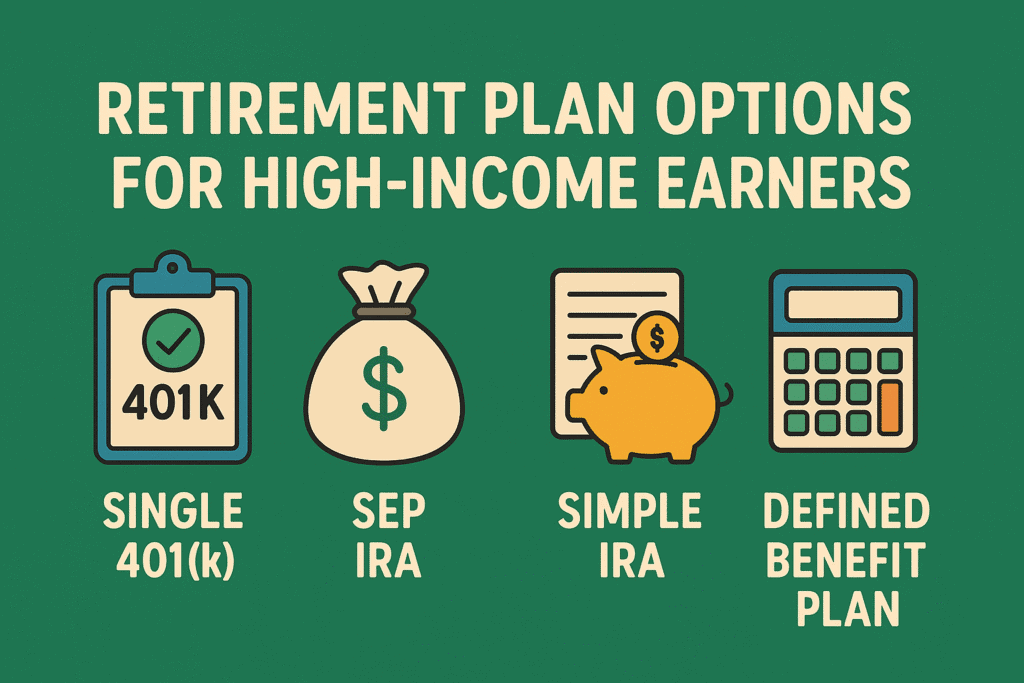
Below, we’ll break down the three main retirement plan options available to high income solopreneurs, entrepreneurs and small business owners:
- Solo 401(k)
- SEP IRA
- SIMPLE IRA
In Part 2, we’ll explore an advanced strategy most people don’t even know exists — the Defined Benefit Plan, which can allow you to contribute $200,000+ per year.
Solo 401(k): The Heavyweight for One-Person Businesses
The Solo 401(k) (also called an Individual 401(k)) is one of the most powerful tools available if you’re self-employed with no full-time employees — or only your spouse.
Key Features:
- Max Contribution (2025): Up to $70,000 — or $77,500 if you’re 50 or older
- Structure: You contribute both as the “employee” (deferral) and “employer” (profit-sharing)
- Roth Option: You can contribute after-tax dollars for tax-free growth
- Loan Option: You can borrow from it, just like a traditional 401(k)
This plan allows you to stack retirement savings fast. For example, if your net income is $150,000, you could:
- Contribute $23,500 as employee deferral (plus $7,500 catch-up if over 50)
- Add up to 25% of your compensation (up to $37,500) as the employer
Downside: The Solo 401(k) only works as long as you have no employees (except your spouse). As soon as you hire full-time help, the plan is no longer compliant. You’ll have to shut it down and transition to a traditional 401(k) or another plan that accommodates employees.
Still, for high-income solopreneurs, just starting our entrepreneurs or self-employed individuals like real estate agents, this is usually the first — and often the best — place to start.
SEP IRA: Big Contributions, But Less Control
The SEP IRA (Simplified Employee Pension) is a favorite among small business owners because it’s easy to set up and allows for large contributions but it comes with strings.
Key Features:
- Max Contribution (2025): Up to 25% of compensation, capped at $70,000 for 2025
- Employer Funded Only: No employee deferrals allowed
- No Roth Option
- Easy Setup: Minimal forms, low maintenance
The Big Catch: If you have employees, you must contribute the same percentage of their salary as you contribute to your own.
Example:
- You earn $200,000 and contribute 25% ($50,000) to your SEP IRA.
- You have one employee who earns $60,000.
- You must contribute 25% of their salary too — $15,000 — whether or not they ask for it.
This can get expensive fast as your team grows.
Another downside? Employees don’t need to contribute a dime. While that may sound generous, it can backfire. Many business owners prefer retirement plans that reward employees who participate, not just hand out money regardless of behavior.
SIMPLE IRA: Affordable and Familiar
If you have a few employees and want a plan that’s easy to manage and familiar to your team, the SIMPLE IRA is a solid option.
Key Features:
- Max Employee Contribution (2025): $16,500 (+$3,500 catch-up if 50+)
- Employer Match: Either:
-
- Dollar-for-dollar match up to 3% of salary (if the employee contributes), or
- 2% non-elective contribution to all employees.
- Low Admin Cost: Very easy to set up and maintain
Unlike the SEP IRA, employees must contribute in order to receive the match — if you choose the matching structure. That’s a big win for employers who want to incentivize smart financial behavior instead of just giving out retirement money to everyone, regardless of participation.
Limitation: The contribution limits are much lower than a Solo 401(k) or SEP IRA. If you’re earning $200K+ a year, you’ll likely outgrow a SIMPLE IRA pretty quickly.
Still, for a small business with moderate income and a couple of employees, it’s a low-friction, low-cost starting point.
How to Choose the Right Plan
Here’s a simple way to look at it based on your current situation:
Situation |
Likely Best Option |
|---|---|
| Solo business, no employees | Solo 401(k) |
| You want to max tax savings, don’t mind contributing for employees | SEP IRA |
| Small team, want low-cost setup and shared contributions | SIMPLE IRA |
| You’re earning 7 figures and want to shelter $200K+ | Defined Benefit Plan (coming in Part 2) |
Remember: the best plan isn’t just about the numbers — it’s about your strategy. Do you want flexibility? Do you want to incentivize employees to save? Do you want to aggressively reduce taxable income?
Coming Next: The $200K+ Strategy Most People Miss
If you’re consistently earning high six or seven figures, there’s one retirement strategy that’s rarely discussed: the Defined Benefit Plan.
It’s not for everyone — it’s complex, requires ongoing actuarial calculations, and must be funded consistently. But if you’re the right candidate, it can allow you to shelter $200,000 or more per year, pre-tax.
And it works even if you have employees — there are creative ways to structure it to maximize your benefit while managing costs.
Stay tuned for Part 2 — we’ll break it down in plain English.
Final Word: Turn Your Retirement Plan into a Wealth Engine
The right retirement plan can do more than just help you retire — it can shrink your tax bill, reward key employees, and build long-term wealth faster than most people realize.
Most high-income business owners wait too long to upgrade their plan — or never do. The earlier you act, the more you can leverage compound growth and tax advantages.