I’ve come to believe there are two kinds of people: tourists and explorers.
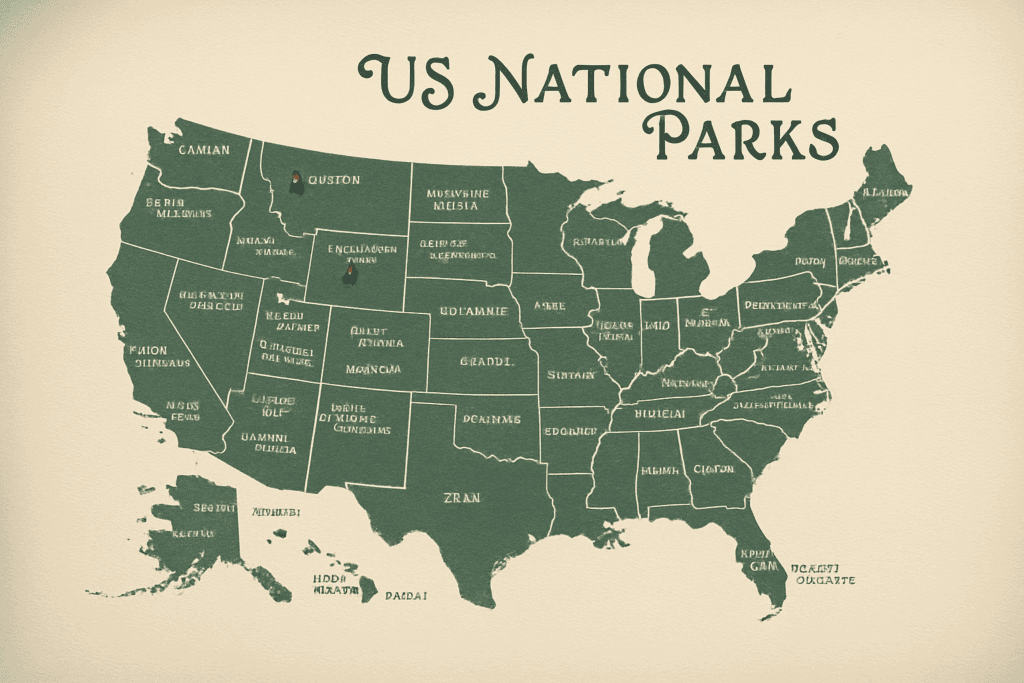
Several years ago, my wife bought me a hand-drawn map of the United States with the locations of all 63 National Parks. It came with little pins to mark the parks we had visited. It seemed simple enough—stick a pin where you’ve been. But @wild_woman_mt set the rules: you only get to pin a park if you’ve really seen it, not just been to it.
That meant no pins for Acadia, even though we live in Maine. No pins for Yellowstone or Grand Teton either, despite the fact we lived in Jackson Hole in 1992–93 and went into those parks several times. Her point was that back then we were tourists—we hadn’t really dug in.
Over the 32 years since, we’ve changed. We’re explorers now. We like to slow down, notice the details, and discover the hidden corners.
The TikTok Effect
I read an article the other day about formerly quiet corners of Acadia National Park being “discovered” by TikTok. One post had 34.4 million views. That’s not just viral, that’s explosive. Anyone who dabbles in social media knows how staggering that is. Viral usually means your content escapes your immediate circle and maybe multiplies its reach 100 or 200 fold. But sometimes, the algorithm pushes it into the stratosphere.
For content creators, chasing virality is like trying to hit grand slams every time you step up to the plate. It’s thrilling when it happens, but few build a lasting career that way. The better strategy is to focus on consistency—hitting singles and the occasional double—because that’s what builds momentum over time. Same principals apply to long-term investing and climbing 14ers. We’ll cover those topics in future posts.
In digital marketing, the same principle applies: steady, reliable content compounds into trust and growth, while swinging only for grand slams often leads to burnout. That’s a bigger conversation for another post, but it connects directly to how explorers and creators approach the long game.
Tourists vs. Explorers
You can spot a tourist in conversation. Mention a place and they’ll often cut in—“Oh, I’ve been there!” They’ll share a quick story, then move on. Explorers, by contrast, return again and again. They see the same place through different eyes each time.
Last November, Kerry and I went to Glacier National Park for the first time, but most of the roads were closed. We’ll return in a couple of weeks with my sister and her husband. When we asked what they wanted to see, they didn’t hand us a checklist. They just said, “Mountains, wildlife, rivers, waterfalls—whatever you think we should see.” That’s the explorer’s mindset: trust the guide, follow curiosity.
Stories from the Road
Last year, we learned that the best discoveries come from conversations with people who live the parks.
The young man at Yellowstone Forever. We first met him because it was one of the only places with an open restroom in winter. He’d taken the job just to be close to the park. At first, he tried to answer our questions about wolves (as if anyone can really predict where they’ll be). But when we asked about birds and wildflowers in spring, his whole face lit up. Passion is like that—it gives away where the real treasures are.
The couple with the motorhome. This summer, we spotted them pulled over near Silver Gate with a spotting scope. Anyone who frequents the parks knows this trick: follow the scopes, not the crowds. They were camped there for a few hours, watching the cliffs where mountain goats appear as tiny white flecks. To the untrained eye, they’re just rocks. But with practice—and the right equipment—you learn to tell the difference.
That’s the explorer’s way. You scan with your eyes, then binoculars, and finally a scope. You don’t start zoomed in; you start broad and attentive. Rick Rubin writes, in The Creative Act – “Look for what you notice but no one sees.” You begin by noticing what others overlook, before you ever try to refine or magnify it.
The Creative Parallel
Exploration and creativity share the same discipline: learning to see what others don’t.
Almost anyone can snap a photo of Old Faithful, the Tetons, or a roadside bear or bison. The real creatives—the explorers—find the wolf crossing a snowfield at dawn, the mountain goats blending into cliffs, the fleeting light others walked past. To see what I mean, check out @isaacspicz on Instagram or at isaacspicz.com.
It’s the same with ideas. Tourists skim the surface; explorers notice the hidden patterns. Tourists collect pins; explorers collect perspective.
The takeaway is simple: whether in nature, creativity, or life—learn to see what others don’t.