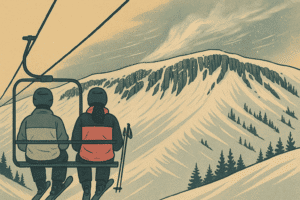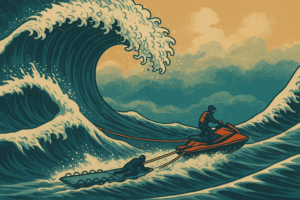
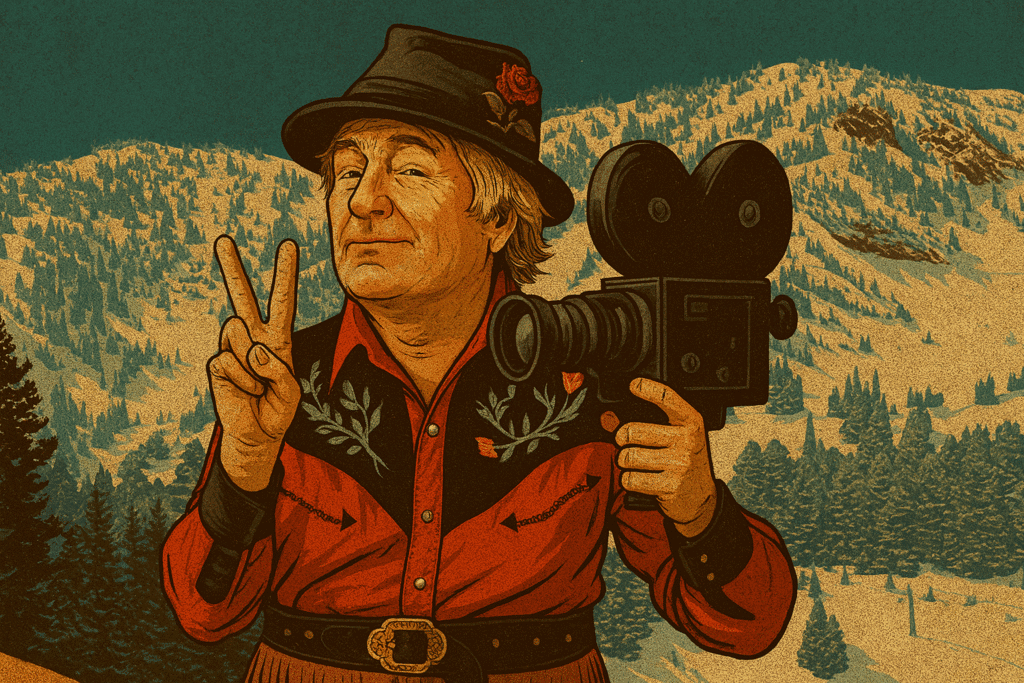
Before there was Teton Gravity Research, before Matchstick Productions, before “big-mountain skiing” became a marketing term, there was a kid from Gorham, Maine with a camera, a chip on his shoulder, and a soundtrack that didn’t sound like anything the ski world had ever heard.
From Pleasant Mountain to Punk-Rock Ski Cinema
Greg Stump grew up skiing Pleasant Mountain (formerly Shawnee Peak) and came out of Maine’s freestyle scene when mogul runs and ballet skiing were still the sport’s wild frontier. He didn’t just ski the rules — he blew them up. In one early competition he literally started his run by detonating a small charge, a moment that forced rule changes and cemented his outlaw reputation.
That raw, independent streak carried him west, camera in hand. Where other filmmakers chased postcards, Stump chased energy — grit, humor, rebellion, and the pulse of mountain subculture. His films The Blizzard of Aahhh’s (1988), Dr. Strange Glove (1990), and Groove Requiem in the Key of Ski (1991) didn’t just document skiing; they invented a visual and sonic vocabulary that every ski film since has borrowed.
Big-Mountain Skiing Before the Term Existed
When people talk about big mountain skiing today — that blend of freeride terrain, consequence, and artistry — they’re speaking a language Greg Stump helped write. Long before GoPros and heli budgets, Stump was hauling cameras into Chamonix, Telluride, and Squaw Valley, showing the world what happens when athletes like Glen Plake and Scot Schmidt turn gravity into a canvas.
The shots were raw, the soundtracks edgy (think early electronic, punk, funk, and jazz), and the editing was pure velocity. It felt less like a ski movie and more like a rock video — because that’s exactly what Stump intended.
Bridger Bowl: Where the Legend Echoes
Fast-forward to today. Scroll through Bridger Bowl’s Instagram feed and you’ll find a reel titled Way Back II — and the caption reads:
“Special thanks to Greg Stump for letting us use footage from his legendary ski films. The content is from Dr. Strange Glove (1990).”
That same reel lives on YouTube as Bridger Bowl Way Back II. The terrain, the snow, the vibe — it’s all unmistakably Bridger. It’s a bridge between eras: Maine-born filmmaker, Montana mountain, eternal outlaw energy.
When Bridger shares that footage, they’re not just posting nostalgia. They’re paying homage to the man who turned skiing into cinema and rebellion into art.
The Led Zeppelin of Ski Film
If the ski-film lineage were a family tree, Greg Stump is Led Zeppelin. He took blues (old-school ski footage), added distortion (punk editing), and made it loud, dangerous, and immortal.
Teton Gravity Research and Matchstick Productions are the next generations — the stadium tours built on his riffs. Their 8K cameras, drones, and sponsors? All extensions of the raw guitar feedback that Stump unleashed first.
To borrow a R.E.M. line, they’re “standing on the shoulders of giants.” And one of those giants happens to hail from Maine.
Why He’s Still an Outlaw
Because outlaws aren’t defined by how far they go — they’re defined by what they refuse to become. Stump never went corporate. He never lost the mischief, the humor, the creative defiance that started at Pleasant Mountain. He made art that challenged his audience and changed his sport.
In the end, that’s what Mainer Montanan is all about: the meeting of grit and grandeur, rebellion and reverence — the kind of creative energy that starts in the woods of Maine and finds its echo on the ridgelines of Montana.
Footage Reference
🎥 Watch: Bridger Bowl Way Back II (featuring Greg Stump’s Dr. Strange Glove, 1990)
📸 Original reel: Bridger Bowl Instagram — Way Back II