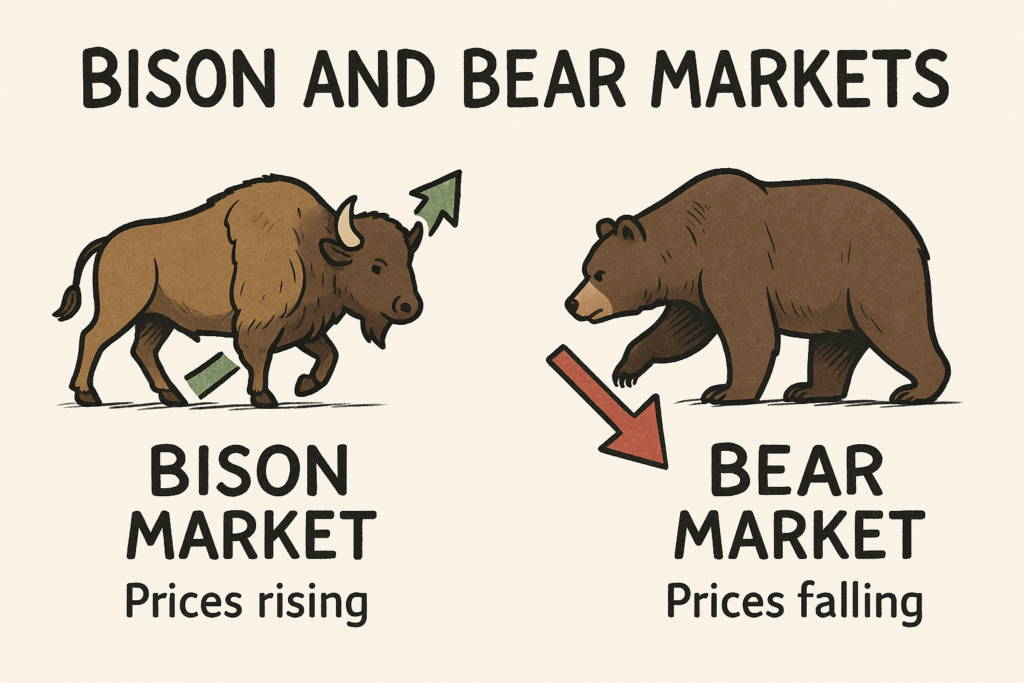
Most people have heard the terms bull market and bear market, but fewer know where the names come from. As a local and remote financial advisor and educator, I like to to use analogies.
Here’s a quick overview before we put our Montana twist on things:
BULL MARKET
- A period when stock prices are rising or expected to rise.
- Typically defined as a 20% or more increase in a broad market index (like the S&P 500) from a recent low, sustained over time.
- Usually paired with strong investor confidence, economic growth, and optimism.
BEAR MARKET
- A period when stock prices are falling or expected to fall.
- Defined as a 20% or more decline in a broad market index from a recent high, lasting at least two months.
- Often linked to weak investor sentiment, slowing economic activity, or financial stress.
 One way to picture it:
- Bull = tosses upward

- Bear = swipes downward

WHY I CALL IT A BISON MARKET
Since we have so many bison in Montana and my day job is being a local financial advisor in both Maine and Montana, I thought it would be fun to give this concept a local twist: the Bison Market.
Anyone who’s spent time in the Greater Yellowstone Ecosystem knows bison can toss you skyward in a second. (Google “touron bison toss” and you’ll see what I mean.)
Beware — bison injure more visitors than bears do. That’s why the park wildlife safety rules exist: 25 yards away from bison, 100 yards from bears and wolves. Ignore them, and you risk serious injury or worse.
Later, I’ll write more about wildlife safety rules and link to it here.
The same is true in markets. When things are going up, people start creeping closer and closer, forgetting the rules. That’s when mistakes get made.
BISON MARKETS (UP MARKETS)
Everyone loves a bison market. Stocks are rising, wages are up, home values climb, and people generally feel richer. Confidence is everywhere.
But here’s the risk: when the good times roll on too long, investors can forget their discipline. They might ignore their recommended asset allocation, take bigger risks, chase hot stocks, or dabble in speculative options and penny shares. Just like walking too close to a bison, it feels exciting — right up until it isn’t.